

Up to 500 pounds towards mediation on child arrangements, not means tested.
What the scheme is
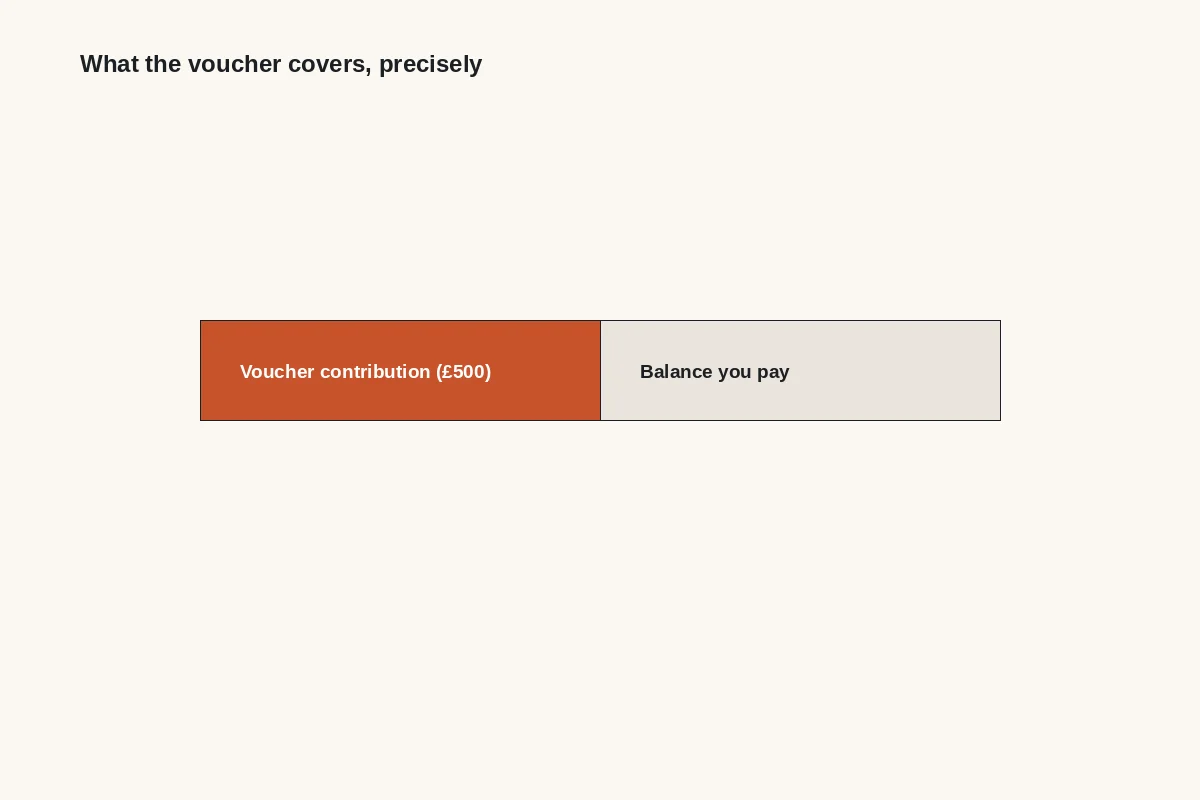
The Ministry of Justice funds a contribution of up to 500 pounds towards family mediation where the dispute involves arrangements for children. It was introduced to reduce the number of child arrangements cases reaching court, and it has been extended several times because it does that.
It is not means tested. That surprises people, because most help with legal costs is. Your income and savings do not affect whether you qualify.
What it covers, and what it does not
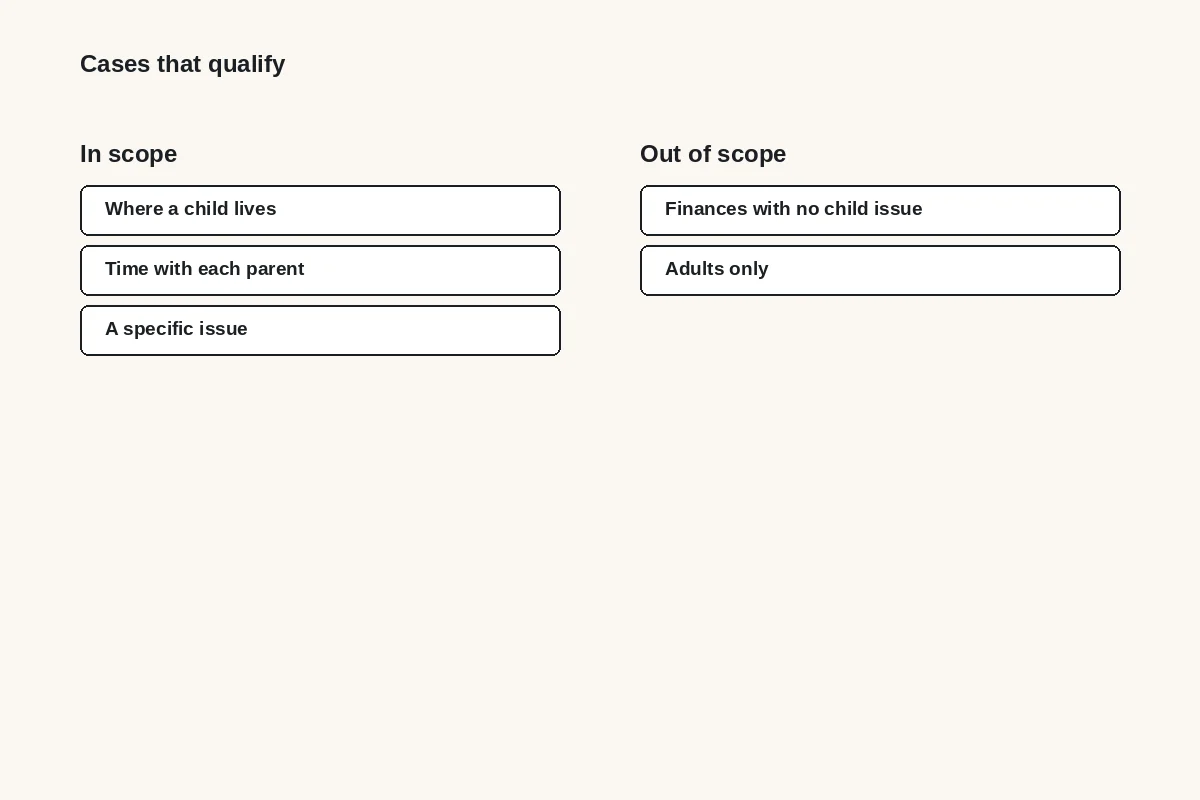
It covers mediation about child arrangements: where the children live, how time is divided, holidays, schooling, and related questions. Where a case involves both children and finances, the voucher applies to the child element and the financial sessions are charged normally.
It does not cover the MIAM. It does not cover solicitors' fees, court fees, or the consent order. And it is a contribution rather than a full payment: where mediation costs more than 500 pounds, you pay the balance.
How it is claimed
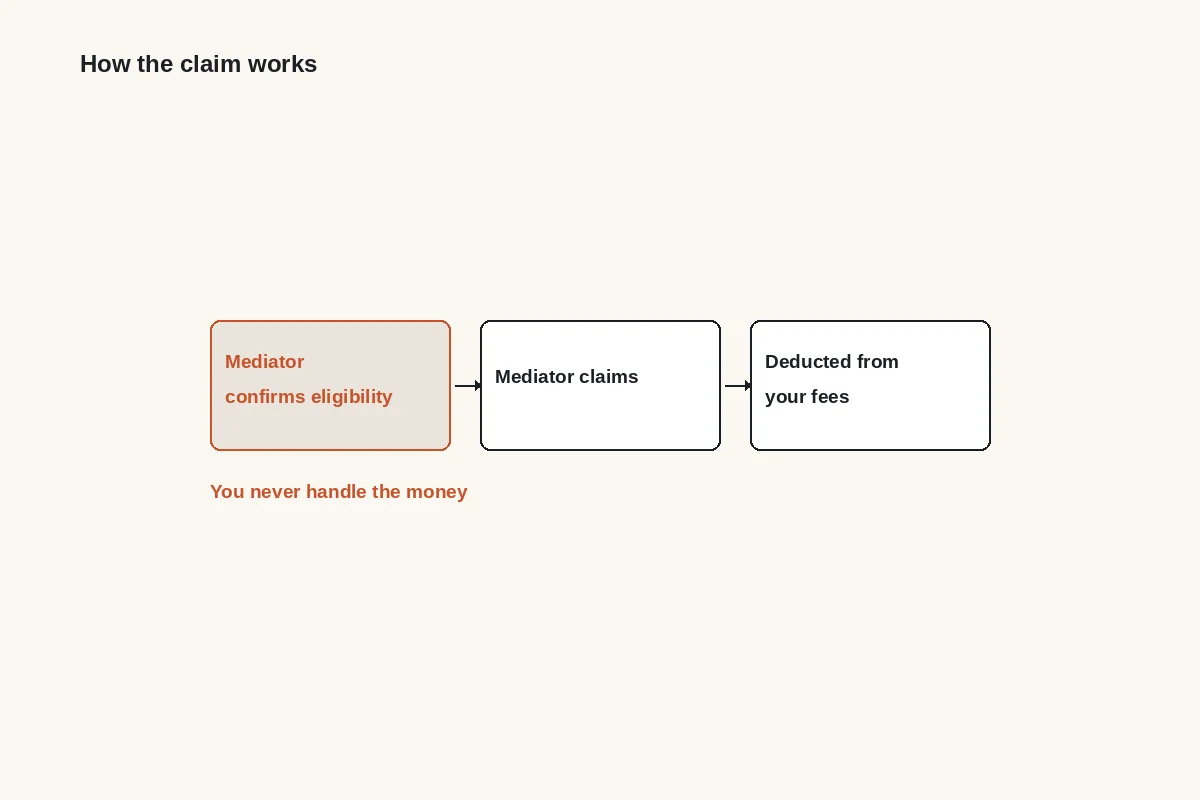
The mediation service claims it. You do not apply, fill in a form, or wait for a decision before starting. The service confirms eligibility, provides mediation, and claims the contribution afterwards, so the amount simply comes off what you pay.
It applies per case, not per person. A separating couple share one voucher rather than receiving one each.
Who qualifies
The case must involve a dispute about arrangements for children, the mediator must be accredited and working for an FMC authorised service, and you must have attended a MIAM. Cases that are purely financial with no child element do not qualify.
Using it alongside legal aid

If either of you qualifies for legal aid for mediation, that generally provides more help than the voucher and the two are not combined. Legal aid makes the MIAM free for both parties and covers the eligible party's sessions. It is worth checking eligibility first, even if you assume you would not qualify, because the assessment costs nothing.
What it means in practice
A typical child arrangements mediation runs three sessions, which at usual rates is somewhere around 700 to 900 pounds in total across both parties, plus the MIAMs. The voucher removes up to 500 pounds of that. For many families it takes the process from something they were weighing up to something they simply book.
Set against a contested child arrangements application, which commonly reaches five figures per party once solicitors are instructed, the comparison is not close.
What the voucher covers, precisely
The contribution is toward the cost of mediation sessions concerning arrangements for a child. It applies to the joint sessions, not to the MIAM, and it is a contribution rather than a full payment: where the mediation costs more than the voucher, you pay the balance.
It is one voucher per family, not one per person, and it is used once. It is not a benefit and it is not means tested, so household income does not come into it. A family with substantial assets qualifies on exactly the same terms as one without.
Cases that qualify
A dispute about where a child lives, about the time a child spends with each parent, about a specific issue such as schooling or medical treatment, or about a prohibited step. Those are the core.
Also qualifying is a case that involves both a child arrangements issue and a financial issue. Where a mediation is dealing with both, the child element brings the whole case within scope. This is worth knowing, because a couple sorting out the house and the children together frequently assumes the scheme is for child-only cases and does not ask.
Cases that do not
A financial case with no child arrangements element in it at all. A dispute purely between adults, such as one about the division of property between former cohabitants where no child is involved. And a case involving a child where the issue in dispute is not about arrangements for that child.
Who administers it
The Family Mediation Council administers the scheme on behalf of the Ministry of Justice. Only mediators authorised to take part can access it, which in practice means an FMC registered mediator working for an authorised provider.
This is the practical filter that matters when choosing a service. A mediator who is not registered cannot offer the voucher at all, however capable they are, and there is no route to claiming it afterwards.
How the claim works
You do not apply for the voucher and you do not receive money. The mediator confirms the case is eligible, applies for the voucher on your behalf, and then deducts the contribution from the fees. The funder pays the mediator directly.
What you will be asked to do is confirm that you understand the scheme and consent to the mediator claiming it, and provide the details the scheme requires. It is a short form and it takes minutes.
Because the deduction is applied to the fees rather than paid to you, there is nothing to reclaim and no reimbursement to chase.
How the deduction is usually split
One voucher covers the family, and how it is applied between two people is a matter for agreement. The two common approaches are splitting the contribution equally, so each party's bill reduces by half of it, or applying it entirely to one party's fees where that party has substantially less income.
Agree this at the outset. It is a small point and it is easier settled before anyone has an invoice than after.
Whether it is worth it if you would mediate anyway
Yes, and the reason is not only the money. Making the arrangements is straightforward, it does not lengthen the process, and the money it frees up frequently pays for the independent legal advice that makes the resulting agreement safer to rely on.
For a typical child arrangements mediation, the voucher covers a substantial part of the total. It is the difference between two sessions being affordable and four being affordable, and four sessions is often what a properly worked parenting plan actually takes.
What happens if mediation does not resolve everything
The voucher is not conditional on reaching agreement. If mediation ends without a full agreement, the contribution already applied stands. Nothing is repayable.
Partial agreement is common and it is not a wasted process. A case that resolves the schedule and leaves one point outstanding is a considerably narrower case if it does go to court, and courts notice the difference.
The scheme is not permanent
It has been extended more than once since it was introduced and it operates within a funded allocation. It is not a statutory entitlement, and a scheme that depends on a departmental budget is a scheme that can be changed or closed.
The sensible position is to check current availability with an authorised mediator when you enquire rather than relying on what a page said at some point in the past. Any registered service will tell you where the scheme stands that week.
Legal aid, which is a different thing
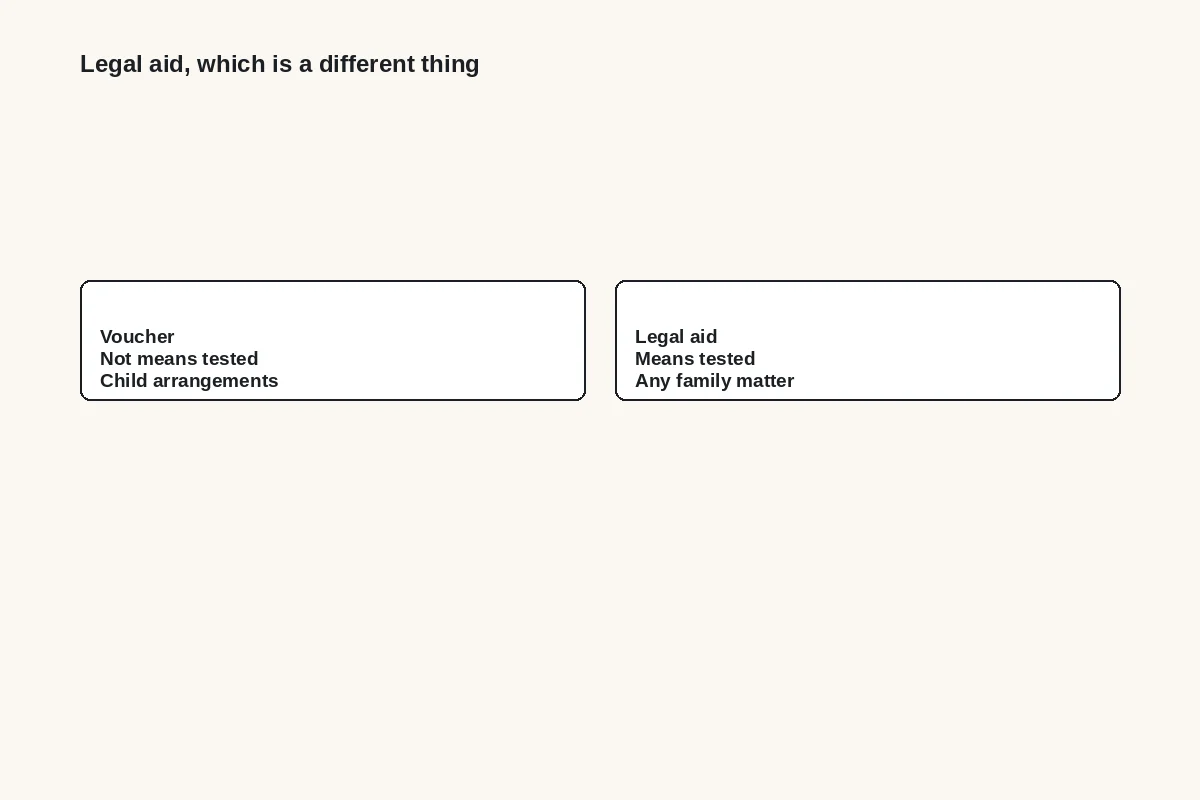
Legal aid for family mediation still exists and it is separate from the voucher. It is means tested, and where you qualify it can cover the MIAM and the mediation sessions in full, including for financial cases.
Importantly, where one party qualifies for legal aid, the MIAM is generally free for both. That is a point many people never discover, and it is worth asking about before assuming a cost.
You cannot use legal aid and the voucher for the same sessions. If you qualify for legal aid, that is usually the better route, and a mediator will tell you which applies to you.
Questions worth asking before you book
Whether the service is authorised to offer the voucher, which is a yes or no answer. Whether your case is within scope, which the mediator assesses at the MIAM. Whether the scheme is currently open, since it operates within an allocation. And how the contribution will be applied between the two of you.
Ask all four in the first conversation. They take a minute and they determine several hundred pounds.
What it does not cover, so nothing is a surprise
It does not cover the MIAM, which is charged separately. It does not cover the drafting of the consent order, which is solicitor work rather than mediation. It does not cover independent legal advice. And it does not cover a second mediation later, because it is used once per family.
Knowing the shape of what remains means the figure you budget is the real one rather than the session fee minus the voucher, which is the number people tend to arrive at and then have to revise.
If the scheme is closed when you enquire
It has closed and reopened before. If it is not available in the week you enquire, the practical alternatives are to check whether you qualify for legal aid, which is separate and is not time limited in the same way, and to ask the service what it offers in the way of staged payment.
What is not worth doing is delaying the mediation itself in the hope the scheme reopens. The saving is real and it is smaller than the cost of a case that drifts for two months, and where a court deadline is involved the delay carries a consequence of its own.
One voucher, one family
It is worth being clear about the unit, because it is the point most often misread. The scheme provides a single contribution for the family, not one for each parent, and it is used once rather than renewed if the arrangements need revisiting in a few years.
That is a reason to use it on the mediation that does the substantial work rather than on a first exploratory session, and a mediator will advise on the timing if you ask.
How Mediation Direct can help in Aylesbury
Two separate schemes, frequently confused. Here is which one applies to you.
Frequently Asked Questions About Our Services in Aylesbury
Is the voucher means tested?
No. Your income and savings do not affect eligibility. It applies where the case involves arrangements for children.
Do we each get 500 pounds?
No. It is up to 500 pounds per case, shared between you, rather than per person.
Does it cover the MIAM?
No. The MIAM is charged separately. The voucher applies to the mediation sessions that follow.
What if our case is only about money?
The scheme requires a child element. A purely financial case does not qualify, though legal aid may still be available if you are eligible.
Do I have to apply for it myself?
No. The mediation service confirms eligibility and claims it, so the contribution simply reduces what you pay.
What if mediation costs more than 500 pounds?
You pay the balance. The voucher is a contribution rather than a cap on what mediation costs.
Can we use it and legal aid together?
No. Where legal aid applies it generally provides more support, and it is worth checking that first.
Is the scheme permanent?
It has been extended several times rather than made permanent. We confirm current availability at the enquiry stage.
Does using it affect a later court application?
No. If mediation does not resolve matters, your right to apply to court is unaffected.
What if my ex-partner will not attend?
The voucher applies to mediation that goes ahead. If your ex-partner declines, the mediator signs your court form and no voucher is claimed.
About the author

Authored and reviewed by Family Mediation Council (FMC) accredited family mediators. Every procedural timeline and statutory requirement is verified against the Family Procedure Rules 2010 Part 3 and current Ministry of Justice standards.
- FMC Accredited
- Standards Board Registered
- Authorised MIAM Provider
- MoJ Voucher Scheme
Talk to someone who knows Aylesbury
No obligation, and nothing is decided on the call. We will talk through where you are and what your options actually are.